

The textbook changes rolled out across Syria under the name “Damascus Curriculum”, and what they reveal about the transitional authorities’ vision of women’s and girls’ place in society
Raja Salim — the Syrian Feminist Lobby
On 24 October 2026, Syrian journalist Mohammad al-Salloum published a series of comparisons showing how specific pages in school textbooks had changed between editions approved under Bashar al-Assad and those currently in use. The comparisons revealed women and girls removed from school and public scenes; hijabs and jilbabs digitally added to female figures; the bodies of archaeological statues covered; and artworks and lessons addressing citizenship and public participation eliminated.
Al-Salloum initially drew on a 241-page research report published by IMPACT-se on 19 October 2026, titled The New Syria: Education Under al-Sharaa — Review of Syria’s National School Curriculum, 2025–2026. The report examined 130 textbooks from grades one through twelve, comparing the 2025–2026 editions with earlier ones. IMPACT-se is an Israeli-founded research institute established in 1998, with offices in Israel and the United Kingdom; it is not affiliated with UNESCO. Al-Salloum reviewed the old and new textbook editions himself and published comparisons documenting changes to both images and written content. These comparisons make it possible to verify the alterations directly against editions issued by the Ministry of Education.
From removing Assad’s images and Ba’ath Party slogans to rewriting curricular content
After Bashar al-Assad fled Syria on 8 December 2024, then-Minister of Education Nazir al-Qadri said the ministry would remove references to the Ba’ath Party and symbols of the former regime from school textbooks, while leaving scientific, literary and vocational curricula unchanged. He also affirmed that education was a right for both girls and boys.
In early January 2025, the Ministry of Education published lists of amendments covering different stages of schooling. They included changes to Islamic education textbooks. The phrase “for a person to sacrifice their life for their homeland” was replaced with “for a person to sacrifice their life for God”; “governed by the law of justice” became “governed by God’s law”; and “the principle of human fraternity” became “the principle of fraternity in faith”.
The amendments also removed the unit “The Origin of Life and Evolution” from the science curriculum, erased references to ancient peoples and historical figures — including Zenobia, the Arameans and the Canaanites — and deleted texts and images related to the arts, as well as lessons and pages from philosophy courses.
The growing scope of these changes prompted public and professional objections. What the ministry had announced as an effort to remove Assad-era propaganda had expanded into scientific, historical and philosophical material, as well as religious concepts. Critics also objected to changes affecting the identity of education being made without an announced specialist committee or an open public discussion among educators. As the controversy widened, al-Qadri said the curricula would remain unchanged until specialist review committees were formed, and that the announced amendments were intended to correct information in Islamic education.
On 9 January 2025, the ministry issued Decision No. 104, abolishing the National Education subject. It redistributed the marks allocated to social studies equally between history and geography and removed the subject’s marks at the secondary level. In May 2025, Syrians for Truth and Justice reported that the ministry had yet to name any academic or educational review committee, publish its methodology, or set a timetable. The promised institutional review remained absent, while amendments had already been introduced with no public account of who drafted them, which criteria they used, or how the decisions were reached.
On 17 August 2026, the ministry announced that the curriculum used during the 2025–2026 academic year would be adopted in all governorates for 2026–2027. One month later, the Minister of Education told the People’s Assembly that the ministry had printed 41 million textbooks and that images and symbols associated with the former regime had been removed from the two most recent editions. With this nationwide rollout, the altered pages reached schools in governorates that had used different curricula the previous year. Their scope expanded from editions applied under what the ministry called the “Damascus Curriculum” to standardised educational content for the entire country, including children who had previously studied under other curricula.
From a digitally altered doctor to an erased girl
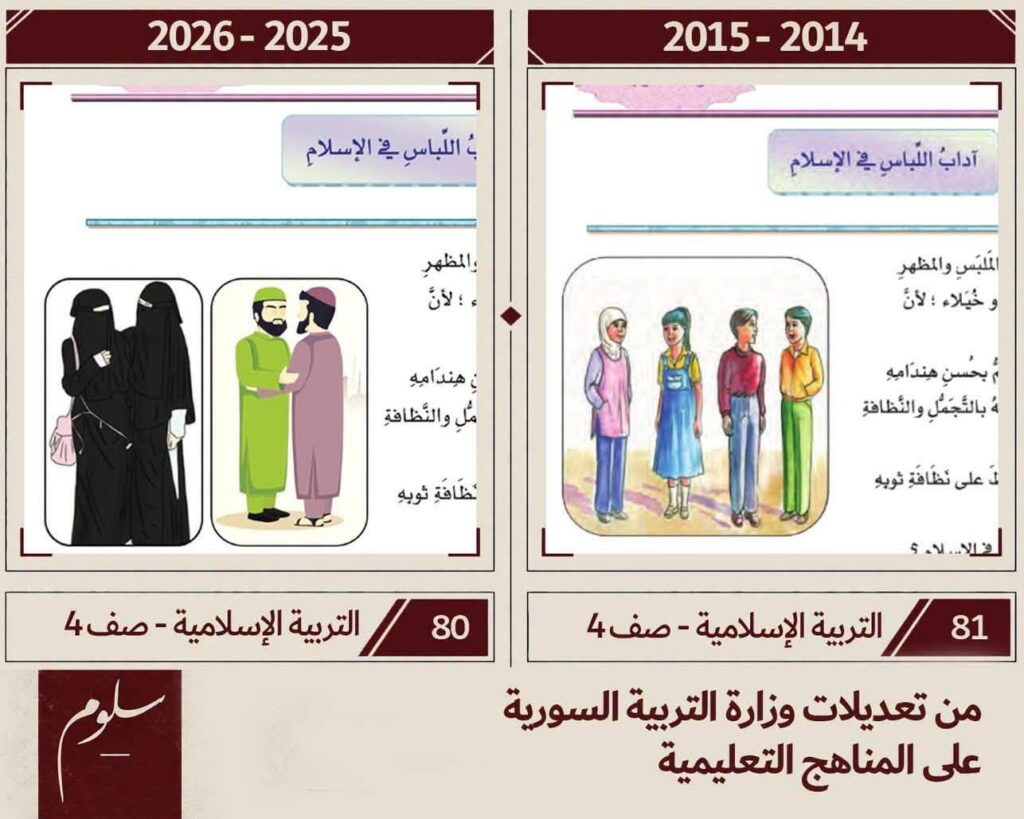
The comparisons reveal several forms of intervention. In a grade-one social studies textbook, a woman doctor appears without a head covering in the 2021–2022 edition. In the 2025–2026 edition, the same figure appears with a hijab digitally added. In the grade-four Islamic education textbook, an image of young women and men wearing varied clothing was replaced with one imposing a single conservative model of dress, extending to the abaya and niqab.
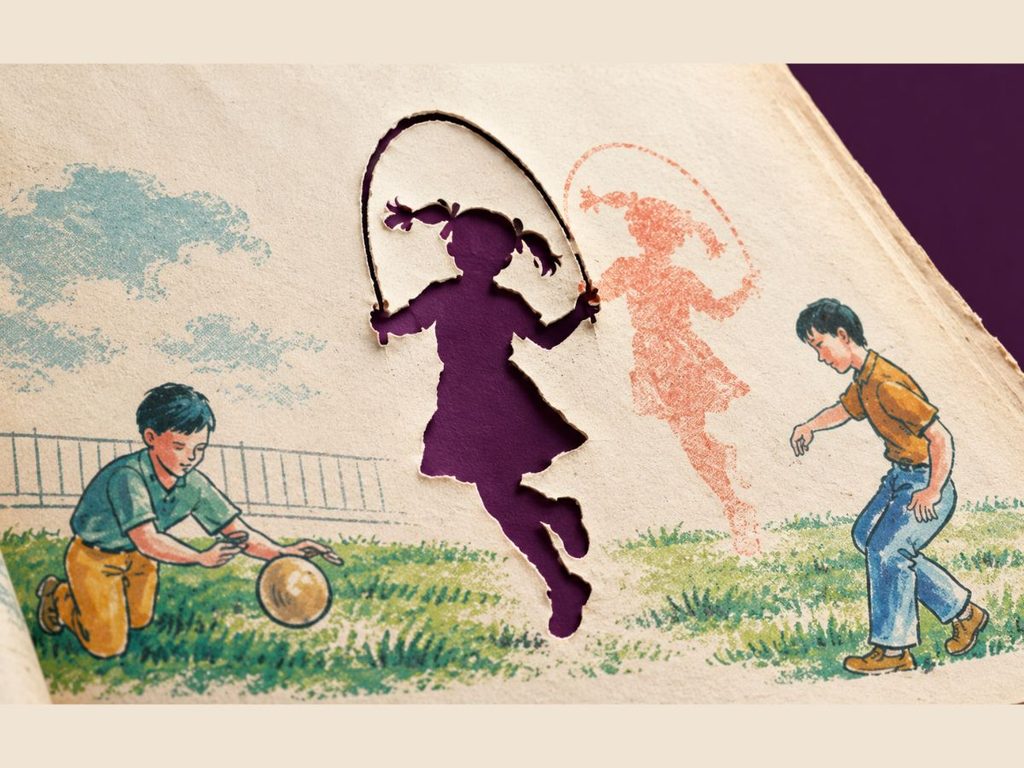
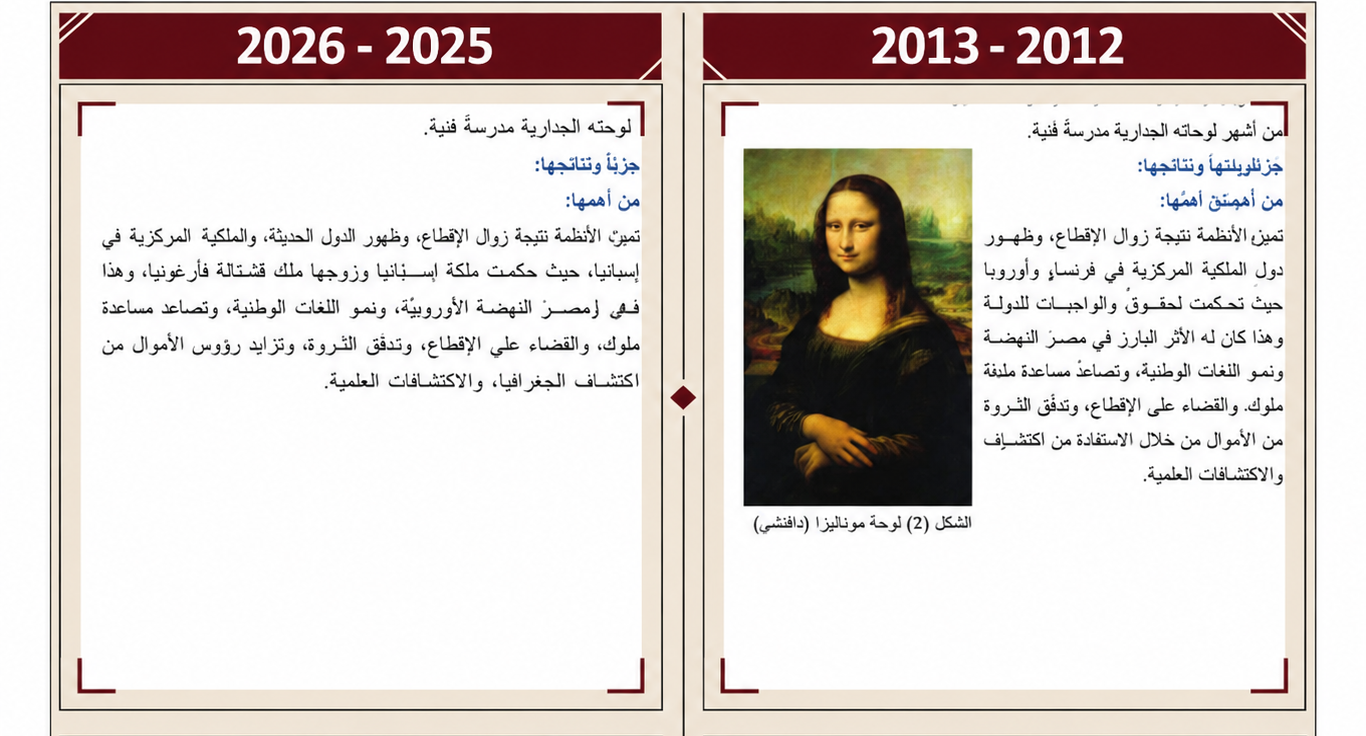
There are also instances of complete removal. Female students were taken out of a lesson about institutions. A girl jumping rope was removed from a scene of children. Women and girls disappeared from parks, streets, markets, and some social and cultural activities. An image of Urnina, the singer and priestess from the civilisation of Mari, was removed from the grade-three social studies textbook. Leonardo da Vinci’s Mona Lisa was deleted from a grade-seven history lesson on the Renaissance while the accompanying text remained. The body of an ancient Egyptian scribe statue was covered with clothing digitally added to the image. Pages, images and questions related to the performing arts were also removed
When the grade-six social studies textbook — first issued in the 2012–2013 academic year under Assad — was
republished, the deletions extended beyond material glorifying the former regime. Lessons about local administration, political life, citizenship, media and democratic participation were also removed.
How textbook images draw a girl’s place in society
Images in school textbooks perform an educational function no less important than written text. Children read a scene before they can fully grasp abstract concepts. From it, they infer who works, who makes decisions, who moves freely in the street, who enters institutions and who represents the nation. A girl searches these images for the possibilities of her own future. Does she see women in medicine, employment, the arts and public life? Does she find a girl playing, learning and participating like the other children? Or do women remain visible only after their clothing has been altered, while girls disappear when a scene becomes public or institutional? When the pattern is repeated, the roles a girl can imagine for herself begin to narrow, even if the text continues to speak of equality in carefully polished language.
When art and history are reshaped
Removing Urnina and the Mona Lisa, and covering the ancient Egyptian scribe, changes the knowledge the books convey. Urnina belongs to the heritage of Mari. Her presence introduces students to the history of their cities and to the place women occupied in the civilisations of the region. Removing her image takes a woman out of ancient Syrian history and impoverishes the lesson itself.
Deleting the Mona Lisa from a lesson on the Renaissance while retaining the text turns the lesson into an incomplete explanation, separating the information from the visual example that helps students understand the period and its artistic history. One of the keys to understanding the painting lies in looking at the woman’s face and considering the expression and enigmatic smile that have occupied artists and scholars for centuries. How can the history of a painting, whose fame rests in large part on what we see in its subject’s face, be taught after that face has itself been removed from the lesson?
Covering the body of the ancient Egyptian scribe with contemporary clothing presents false historical information. The added clothes belong neither to the period of the statue nor to its original form, and they are unsupported by any archaeological approach that could be explained to students. The historical object itself is altered and the edited image is then presented in a textbook as though it documented the original. Students lose the opportunity to see the artefact as it has come down to us and to understand differences among eras, cultures and ways of representing the body. They receive a version of history reformatted according to a contemporary ideology unrelated to archaeological truth.
The deletions extend to history, literature and language
Removing Urnina and the Mona Lisa, and covering the ancient Egyptian scribe, changes the knowledge the books convey. Urnina belongs to the heritage of Mari. Her presence introduces students to the history of their cities and to the place women occupied in the civilisations of the region. Removing her image takes a woman out of ancient Syrian history and impoverishes the lesson itself.
Deleting the Mona Lisa from a lesson on the Renaissance while retaining the text turns the lesson into an incomplete explanation, separating the information from the visual example that helps students understand the period and its artistic history. One of the keys to understanding the painting lies in looking at the woman’s face and considering the expression and enigmatic smile that have occupied artists and scholars for centuries. How can the history of a painting, whose fame rests in large part on what we see in its subject’s face, be taught after that face has itself been removed from the lesson?
Covering the body of the ancient Egyptian scribe with contemporary clothing presents false historical information. The added clothes belong neither to the period of the statue nor to its original form, and they are unsupported by any archaeological approach that could be explained to students. The historical object itself is altered and the edited image is then presented in a textbook as though it documented the original. Students lose the opportunity to see the artefact as it has come down to us and to understand differences among eras, cultures and ways of representing the body. They receive a version of history reformatted according to a contemporary ideology unrelated to archaeological truth.
The deletions extend to history, literature and language
Later comparisons published by al-Salloum documented further changes to history and Arabic-language textbooks. Sultan Pasha al-Atrash and Saleh al-Ali were removed from a paragraph about leaders of the Great Syrian Revolt. Abd al-Rahman al-Kawakibi and his book The Nature of Despotism were also deleted. Badr Shakir al-Sayyab’s poem “Rain Song” was removed without the ministry publishing an educational explanation for its deletion.
Other changes replaced the phrase “Ottoman occupation” with “foreign occupation” and renamed the Great Arab Revolt led by Sharif Hussein as the “Hussein Rebellion”. The greetings “hello” and “good evening” were removed from a lesson on greeting etiquette, leaving “peace be upon you” as the sole example.
The changes vary in scale and effect, and each needs to be read in the context of its textbook and lesson. Their cumulative reach is nevertheless striking: the editorial hand extends to historical figures, the names given to events, literary texts and even everyday greetings. No published document explains the criteria behind these choices.
The ministry’s response and the questions it left unanswered
On 26 October 2026, the Ministry of Education said that changes made to the curricula since Bashar al-Assad fled were limited to a single amendment announced in January 2025. According to the ministry, that amendment sought to remove symbols and ideological content associated with the former regime and to correct related images and material. The ministry added that curriculum development aimed to protect social diversity and reinforce citizenship, belonging and respect for others.
The statement dates the decision on which the ministry says the changes were based. It leaves the altered pages unexplained. Removing a girl from a scene, adding a hijab to a doctor, covering an archaeological statue, and deleting the Mona Lisa, Urnina, “Rain Song”, al-Kawakibi and leaders of the Great Syrian Revolt all require specific educational reasons. The same applies to lessons on citizenship, local administration and democratic participation: placing their removal under the broad heading of eliminating former-regime symbols explains nothing about why those lessons were targeted.
The response also fails to identify who prepared the changes, who reviewed them, when each alteration was entered into the books, or why no comprehensive list of deleted and replaced pages was published. The ministry’s assertion that the changes originated in a single decision does not answer questions about their substance or implementation, particularly after the editions were distributed nationwide and millions of copies printed.
The ministry could have published a change log comparing old and new pages, the decisions of the writing and review committees, and the educational reasoning behind each amendment. That record would move the discussion onto firm ground. Information about books read by millions of children should not have to be pieced together from images uncovered by a journalist and broad statements issued by the ministry.
Citizenship after the abolition of National Education
The Assad regime turned National Education and Arab nationalist studies into instruments of indoctrination and glorification of the ruling authority. Their review was an educational and political necessity. The ministry chose to abolish the subject altogether in January 2025. The question still unanswered is what content will now introduce students to citizenship, their rights and the workings of state institutions after the regime’s propaganda has been removed.
Deleting lessons on local administration, political life, media and democratic participation from the grade-six textbook widens that gap. Children who have lived through years of war, displacement and competing authorities need to understand the state, the law and public responsibility more than ever. Withholding these concepts does not free them from Assad’s ideology. It leaves room for a new ideology and gives them no tools for questioning authority or participating in public life.
When criticism of the authorities is branded a defence of Assad
The political climate makes this discussion especially sensitive. Article 49 of the Constitutional Declaration issued in March 2025 criminalises the glorification of the Assad regime and its symbols, as well as the denial, praise, justification or minimisation of its crimes. In June 2026, the Ministry of Justice announced that it was preparing legislation to regulate the implementation of this article. The text does not criminalise a failure to publicly condemn the former regime, nor does it criminalise criticism of the transitional authorities.
Political language, however, does not stop at the courthouse door. In everyday Syrian debate, labels such as “regime remnants” and “Assad’s orphans” are sometimes directed at people who criticise the current authorities, even when their objection concerns school curricula, women’s rights or the management of the transition. Reports published in 2026 documented uncertainty about the limits of permissible criticism, prompting some journalists and citizens to exercise caution and self-censorship.
In the case of the curricula, the phrase “removing the regime’s legacy” can become a shield that closes the discussion before it begins. Assad’s images and Ba’athist propaganda should be removed. That task must remain distinct from deleting art, history, citizenship and women. Objecting to the digital addition of a hijab to a doctor or the removal of a girl from a scene is an objection to the introduction of a new ideology under a heading treated as immune from criticism. It is not a defence of Assad’s curricula.
The curricula within a broader pattern of excluding women
In less than two years, a series of official decisions and practices has narrowed women’s place in public life, from access to education and employment to representation in governing institutions. They came from different bodies and arose in different contexts, yet women’s participation remains subject to conditions set by those in power. Rights and opportunities are left vulnerable to the next administrative instruction or political decision.
When the transitional government was formed in March 2025, Hind Kabawat was its only woman member, serving as Minister of Social Affairs and Labour. Women’s representation in government was thus reduced to one woman in a country where women, across their diverse backgrounds and experiences, constitute roughly half the population.
In the system used to select the People’s Assembly, women were required to make up at least 20 per cent of the electoral bodies, but no minimum was guaranteed for their representation in the Assembly itself. Their access to legislative power was left to the results of the selection process and subsequent appointments. Only six women won through the indirect selection stage. The transitional president then appointed 15 women within the one-third of seats allocated to him, bringing the total to 21 women out of 210 members — around ten per cent. Fifteen of the 21 women therefore entered through presidential appointment. The appointments improved the numerical outcome in this term, while the selection system itself remained unable to guarantee women’s representation. The proportion could fall again in a future term if the decision of the appointing authority changes.
In January 2026, a circular issued in Latakia prohibited women employed in public institutions from wearing makeup during working hours, under threat of disciplinary action. The university admissions process for 2026–2027 subsequently closed most programmes at the defence and security universities to women. At the National University for Defence Sciences, the restrictions included management and economics, legal sciences and social sciences, alongside military and security programmes. Admissions documents also showed restrictions in institutes for oil and gas, railways and some media specialisations.
The Ministry of Higher Education said that most fields were open to both sexes, and that the exceptions reflected the nature of the work and the requirements of the bodies concerned, or were based on older policies and low demand. This response does not address the restriction of law, social sciences and management to men within an institution intended to train state personnel. Describing some rules as old explains their origin; it does not grant them new legitimacy. Their age is part of the problem. Reprinting them in a new admissions notice gave inherited discrimination a new date and the ministry’s seal, turning it into an enforceable rule during a transition that should be reviewing and dismantling that legacy.
The decisions come from different institutions, but their effects meet in the same place: a textbook alters a woman’s appearance; an admissions notice closes a field of study to her; the political system makes her presence dependent on appointment; and an administrative circular polices her face at work. The textbook then carries these boundaries into the classroom.
Repeated across school, university, employment and politics, these boundaries teach a recognisable order of space and power. A man enters a field of study, an institution or a decision-making room as the expected presence. A woman enters under conditions defined by others; she may be excluded, have her appearance reshaped, or see her absence corrected only by a decision from above. Once this order reaches the textbook, it acquires the authority of knowledge. Children encounter it from their earliest years as a rule about what women may do, where they may appear and in what form they are allowed to remain.
Before the new textbooks reach classrooms
The Ministry of Education says it has drafted national standards for new curricula and referred them to the Supreme Council for Education. This stage gives the ministry an opportunity to correct course, provided that the authoring process is brought out of closed rooms and Syrians are told who is writing their children’s books, according to which standards, and how decisions are reviewed before the books reach the printing presses.
In its statement on the changes, the Syrian Feminist Lobby called for a review and for women and men educators, experts and civil society representatives to take part in developing the curricula. Their participation is essential to safeguarding social diversity, equality, human rights, citizenship and democracy.
Such a review requires clear measures:
- Adopt a clear policy for the representation of women and girls, showing them in varied roles and respecting women who wear the hijab and those who do not, without altering women’s images to make them conform to a single model.
- Make dated digital editions of the textbooks publicly available, and establish a transparent channel through which teachers, parents and researchers can raise objections and correct errors before books are reprinted.
- Publish the decisions on which previous amendments were based, along with a log showing what was deleted or replaced in every textbook, the date of each change, and the body that approved it.
- Suspend the use of disputed pages, or issue corrections, until an independent educational review has been completed.
- Announce the names and qualifications of members of the authoring and review committees, ensuring the participation of experts in education, history, art and human rights, as well as representation of Syria’s social and regional diversity.
- Restore material on citizenship, local administration and democratic participation within a curriculum that explains rights and institutions and rejects both partisan and religious indoctrination.
What do children learn from absence
Syria’s new curricula have two responsibilities: to remove Assad’s propaganda from education and to protect knowledge from any authority seeking to redraw society in its own image. Judging a textbook requires more than counting pictures or assessing print quality. It also requires asking what the new editions have done to women’s presence: a woman whose clothing was altered, a girl who disappeared from a scene, and female students removed from an image of an institution. Those choices shape the society shown to children and the place women are given within it.
When a Syrian girl opens her textbook, what future does it show her? Does she see women who resemble the reality around her — different in dress, environment and personal choices — working, studying and participating in art, politics and institutions? Can she find a place for herself as a doctor, artist, judge, researcher or decision-maker? Or does the book offer her a single model of womanhood and treat other women as images to be corrected or figures that can be discarded?
When a boy reads the same page, what does he learn about his female classmate? Does he see her as a full partner in play, knowledge, work and decision-making, or as a presence that can be removed from the playground and the institution, with her appearance determined before she is allowed to remain? What do both children learn about truth when an archaeological statue is dressed in clothing its era never knew, an artwork is removed while its description remains, and a woman disappears from the history of Mari?
Children do not need an explicit sentence telling them that women should be less visible. It is enough for them to see fewer women, in narrower roles and in a single image repeated from one textbook to the next. Women’s place on the page is part of their place in the state being built. Every deletion that appears small on paper can, across thousands of pages and millions of readings, become a low ceiling over the life of an entire generation.
Sources
-
- Changes to Syrian School Curricula Include Deleted Lessons and Obscured Images of Women and Artworks — Verify-Sy, 24 October 2026. [Arabic]
-
- How Did the Education Ministry’s Statement Become Evidence for Denying Changes It Did Not Deny? — Verify-Sy, 26 October 2026. [Arabic]
-
- Ministry of Education: School Curricula Underwent One Amendment in 2025 — Syrian Arab News Agency, 26 October 2026. [Arabic]
-
- The New Syria: Education Under al-Sharaa — Review of Syria’s National School Curriculum, 2025–2026 — IMPACT-se, 19 October 2026.
-
- Unified School Curricula Introduced Across All Governorates for the 2026–2027 Academic Year — Syrian Arab News Agency, 17 August 2026. [Arabic]
-
- Education Minister Briefs the People’s Assembly on Plans to Accommodate Rising Student Numbers and Develop Education — Syrian Arab News Agency, 14 September 2026. [Arabic]
-
- Syria: Curriculum Reform — An Ideological Unilateral Decision Lacking Legitimacy — Syrians for Truth and Justice, 15 May 2025.
-
- Widespread Reactions Among Syrians Following Changes to School Curricula — Al Jazeera Net, 2 January 2025. [Arabic]
-
- Syria’s New Administration Removes National Education from the Curriculum — Asharq Al-Awsat, 10 January 2025. [Arabic]
-
- Syria’s New Education Minister: Girls and Boys Have an Equal Right to Learn — Reuters via Swissinfo, 19 December 2024. [Arabic]
-
- Training Women Police Officers While Reserving Academic Fields for Men — Verify-Sy, 7 October 2026. [Arabic]
-
- Syria: Women Barred from Defense and Security Colleges — Human Rights Watch, 16 October 2026.
-
- Hind Kabawat: The Only Woman in Syria’s New Government — Asharq Al-Awsat, 30 March 2025. [Arabic]
-
- Syria to Establish New Parliament, Testing Inclusivity Pledge — Reuters, 23 September 2025.
-
- Syria’s Sharaa Appoints Lawmakers, Paving Way for New Parliament to Convene — Reuters, 1 July 2026.
-
- This Video Does Not Show Protesters Demanding the Cancellation of Latakia’s Makeup Restriction — Verify-Sy, 2 February 2026. [Arabic]
-
- Text of Syria’s 2025 Constitutional Declaration — Al Jazeera Net, 14 March 2025. [Arabic]
-
- Justice Minister: Denial of the Former Regime’s Crimes Violates the Constitutional Declaration — Syrian Arab News Agency, 29 June 2026. [Arabic]
-
- The State of Syrian Media During the First Year of the Political Transition — Syrian Center for Media and Freedom of Expression, 14 May 2026. [Arabic]