

What criteria determine the exclusion of female students from certain university programs in Syria?
Ola Al-Jari | Syrian Feminist Lobby
Syria’s university admissions process for the 2026–2027 academic year has sparked debate over registration requirements and the allocation of higher education opportunities. It has also raised questions, primarily about the transparency of decisions and the limits of state intervention in students’ educational and career choices.
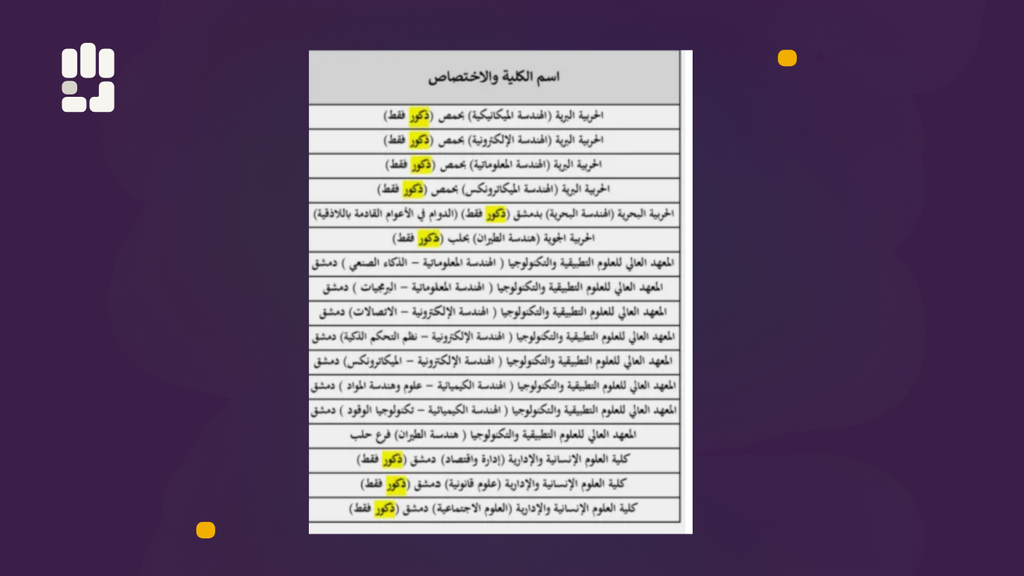
On 30 September 2026, the Ministry of Higher Education and Scientific Research issued the admissions guidelines for the new academic year. They included requirements that reserve admission to certain programs for male students, closing educational and career pathways to female students—some of which had been open to them in previous years.
Gender-based restrictions on university admission are not new in Syria. For example, the Technical Institute for Railways in Aleppo has long been reserved for men, while early childhood education programs and nursing schools have traditionally admitted only women.
But changes to some programs warrant closer attention. At oil and gas institutes in Homs, Deir ez-Zor, and Tartous/Baniyas, programs such as accounting, warehouse management, and precision instruments had been open to female students in previous years. These pathways were closed to them in this year’s admissions process.
Previously, restrictions applied to some military and security programs, as well as technical institutes with specific professional or operational requirements. This year, however, the exclusions have extended to legal, social, and administrative programs within the Faculty of Humanities and Administration at the National University of Defense Sciences, which was recently established and announced at a press conference last July.
Under the admission requirements announced on 30 September, programs in law, economics, administration, and social sciences at the National University of Defense Sciences are open only to men. At the Syrian University of Security Sciences, women may apply only to cybersecurity programs; the Faculty of Security Sciences and the Technical Institute of Security Sciences are reserved for men.
At the National University of Defense Sciences, women are not permitted to enroll in the land, naval, or air military colleges, or in the Faculty of Humanities and Administration. The only program open to them at the university is the Higher Institute for Applied Sciences and Technology, which does not require military service.
Admission to the Department of Radio and Television Directing at the Technical Institute of Media at Idlib University also remains restricted to men.
The new restrictions have therefore added to the old ones rather than seeking to remove them and expand opportunities for female students. They have also barred women from applying to new fields connected to the defense and security sectors.
Many programs remain open to women, but that does not erase the impact of excluding them from particular fields—especially when admission is tied to new employment opportunities and career paths, or when no suitable alternative is available in terms of location, cost, study requirements, and employment prospects.
In a statement issued on 16 October 2026, Human Rights Watch addressed the admission requirements at the National University of Defense Sciences and the Syrian University of Security Sciences, saying that the restrictions on women raise concerns about their role in public institutions during the transitional period.
The organization noted that the admission requirements at these two universities have a different impact from some earlier restrictions: for the first time this year, both institutions are admitting students through the general university admissions process, while excluding women from most programs. Hiba Zayadin, Human Rights Watch’s senior Syria researcher, said the authorities were “rebuilding the army and security forces without women.” She added that women cannot train as officers or even study fields that would qualify them to work as lawyers or administrators in the army. She concluded: “Simply put, this is discrimination.”
The organization acknowledged that women can study law, economics, and social sciences at other public and private universities. They can also join the police through a separate women’s police institute, whose first class graduated in September 2026. But it argued that these alternatives do not address the impact of excluding women from pathways within the defense and security institutions themselves.
This allocation of places raises questions about the basis on which admission requirements were set and whether they align with labor market needs, the demands of study, and the practice of the professions concerned.
I found no published studies among the official and media sources I reviewed that explain the professional and operational basis for reserving these programs for one gender, estimate the sectors’ needs for male and female workers, or clarify why some pathways previously available to female students were closed.
What professional and operational needs make an applicant’s gender decisive when applying to study a particular field? Was the exclusion of female students based on a documented assessment of the requirements of study and professional practice, or on prior assumptions about women’s abilities and suitability for these fields? If there are specific professional requirements, why are they not translated into objective criteria that apply to all applicants?
These questions cannot be answered without official data explaining labor market needs, employment criteria and service obligations, and which bodies requested that places be reserved or proposed the restrictions—whether the ministries of defense, interior, oil, transport, or others. Information is also needed about alternatives considered before these programs were closed, and the appeal mechanisms available to affected female students.
To seek answers, I contacted the Ministry of Higher Education and Scientific Research to ask which body had set the admission requirements; what criteria and studies they relied on; what labor market needs had been identified; why programs previously open to women had been closed; what alternatives were offered; and how students could challenge these decisions. The ministry had not responded by the time this article was prepared.
The debate is not limited to the transparency of administrative decisions. Human Rights Watch considers restrictions on women’s admission to defense and security programs to be inconsistent with Syria’s legal obligations, including the Constitutional Declaration, the Convention on the Elimination of All Forms of Discrimination Against Women (CEDAW), and the International Covenant on Economic, Social and Cultural Rights.
The organization noted that international agreements to which Syria is party include provisions on equal opportunities in education and employment, access to public office, and combating stereotypes based on traditional gender roles. It also argued that excluding women from educational pathways connected to the defense and security sectors undermines their participation in public institutions during the transitional period.
These indicators alone cannot be taken as proof of a systematic policy to prevent women from studying or working altogether. But they merit scrutiny and documentation, particularly in the context of debates and statements about women’s presence and representation in public life since December 2024.
Statements by a member of the Syrian People’s Assembly about what he called the “feminization of education” sparked debate over the idea that women’s numerical majority in the education sector threatens the “strength of students’ personalities” and is an issue that should be raised before the Assembly. Statements by an official of Hay’at Tahrir al-Sham in an interview with Lebanon’s Al Jadeed TV during the first weeks after the fall of the regime also raised questions about his conception of what he called “the nature of women,” and the jobs or tasks women may perform or should avoid.
In its latest statement, Human Rights Watch placed the admission restrictions within a broader context of what it described as women’s marginalization in Syrian public institutions. It noted that women won only six of the 119 elected seats in the indirect People’s Assembly elections in October 2025—about five percent of the elected seats.
The statement also addressed a directive issued by the governor of Latakia in January 2026 prohibiting female public-sector employees from wearing what it called “excessive” makeup, under threat of legal accountability.
These events do not, on their own, prove that a unified policy connects every decision or statement. But they do raise a broader question about women’s place in public institutions, the assumptions shaping their roles, and the extent to which those assumptions influence decisions that determine their educational and professional opportunities.
These restrictions warrant scrutiny of the Ministry of Higher Education and Scientific Research, which announced the admissions process, as well as the relevant institutions and ministries that proposed or approved requirements for colleges and institutes connected to their sectors.
This scrutiny should include disclosure of the criteria and studies on which the decisions were based; an explanation of why admission requirements differ between programs; clarification of why pathways previously open to female students were closed; and disclosure of alternatives considered before the restrictions were adopted. It should also include safeguarding affected students’ right to appeal and seek a review of the decisions, so that restrictions that may appear limited today do not become recurring practices that expand over time