

Nour Suleiman
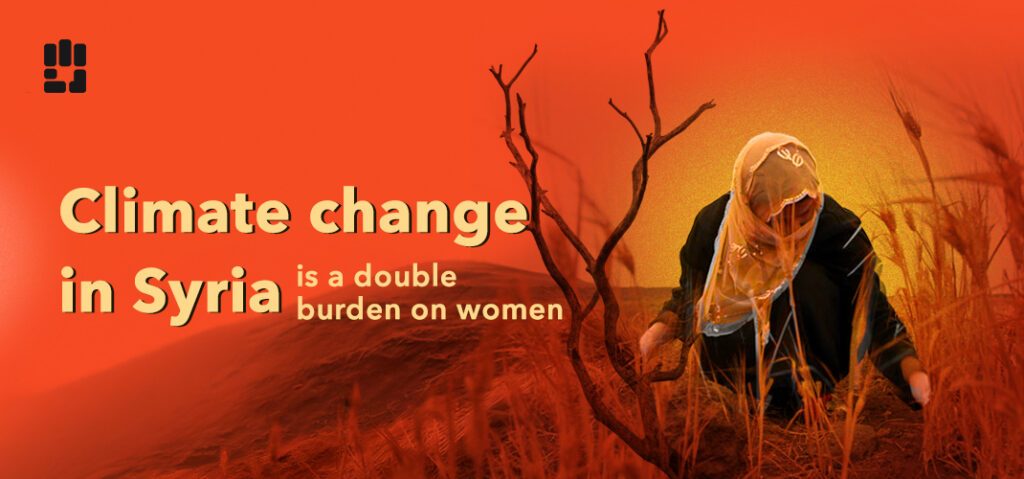
Amid an escalating environmental crisis, the impacts of climate change in Syria are transforming into a harsh social and gendered test, one that not only intensifies pressures on natural resources but places an overwhelming burden on women, who often stand at the front lines of vulnerability.
Climate change is no longer merely an environmental threat; it has evolved into a profound social and gendered crisis. Women—especially in rural areas, impoverished urban neighborhoods, and coastal regions—pay the highest price for the degradation of natural resources due to the intersection of ongoing conflict, recurring drought, and legal fragility. Climate justice from a feminist perspective recognizes that environmental crises do not affect everyone equally, and policy responses must address gender disparities, not just economic or environmental losses.
Both international and local reports confirm this reality. Analyses from multiple regions show that women face a double vulnerability to climate impacts. Yet, at the same time, they demonstrate exceptional capacity to adapt—if given the tools and adequate support.
Agriculture and Drought: Crop Loss and Vanishing Livelihoods
In recent years, Syria has witnessed a significant deterioration in agricultural production due to recurring drought and high temperatures. This has led to a decline in rainfall and the depletion of surface and groundwater resources. According to a 2024 Climate Centre profile, nearly one-third of Syrian farmland relies on rain-fed agriculture, making it highly vulnerable to climate variability. This decline spans across governorates—from the northeast to the Syrian coast.
In the Jazira region, including Hasakeh and Qamishli, research analyses indicate that rain-fed seasons have nearly collapsed this year, pushing many households to rely on solar-powered pumps just to secure minimal irrigation. A study from the LSE notes that women and girls working in agriculture were severely affected by this crop collapse: “Rain-fed agriculture failed completely this year,” according to the report.
Key crops such as wheat have declined, while some local authorities have attempted to adjust agricultural planning in response to water scarcity and rising drought levels.
Along the Syrian coast, rising temperatures and recurring droughts have increased forest fires, causing direct harm to vegetation and small-scale crops on which many families rely. Women are among the most affected, whether in traditional farming or related activities such as gathering wild herbs or beekeeping. With shrinking natural resources, these activities face compounded challenges: lower access to raw materials, declining output, and—critically—the fact that many women lack documentation proving their right to the land they cultivate, depriving them of support or compensation in times of loss.
Women and the Gender Gap in Agriculture
Rural women often perform traditional agricultural labor: harvesting, cleaning, packaging produce, and raising livestock. With declining production, these roles become a heavier burden without proportional returns. What used to be a seasonal source of income has now become recurring, unpaid labor.
Um Waleed from Hasakeh explains:
“We’ve been working in agriculture for years—it was our only livelihood. But everything has changed. Rain no longer falls like before, and the soil dries quickly due to heat. Last season we lost all our work… We had to use pumps to irrigate, but diesel is expensive and we can’t afford it.”
She adds:
“For me, I work longer hours and wait for any chance for the crops to grow, but production keeps falling. It’s hard, especially for women like me, because we have no land ownership papers, and we fear losing everything with no one to compensate or support us.”
Her testimony reflects the reality faced by hundreds of women in Syria, where poverty rates rise, job opportunities shrink, and domestic and agricultural burdens intensify as the environment deteriorates.
Local legal experts note that unclear land ownership rights for women prevent them from accessing support or compensation programs when crops are damaged by drought or environmental hazards.
Gendered Barriers: Inequity Deepened by the Environment
Women in Syria face additional challenges tied to laws and social norms, making them less able to adapt to climate change. Many lack land ownership documents due to customs, inheritance, or displacement. This absence of legal records prevents them from accessing support or compensation.
This gap is not unique to Syria. International reports, including one by “Women for International Climate Justice” titled “Even Climate Change Discriminates Against Women,” estimate that women globally may face climate impacts up to 14 times more than men. The causes include limited access to land, loans, and decision-making positions, alongside social restrictions limiting their access to training and essential information.
A UNDP report for Asia and the Pacific confirms that although women perform more than half of agricultural labor, they legally own only 10–20 percent of agricultural land, weakening their ability to recover from climate-related disasters.
Internal Displacement: Climate Adding a Humanitarian Dimension
Although displacement in Syria has long been associated with armed conflict, local testimonies point to smaller yet recurring displacement waves caused by water scarcity or crop losses. Some families from rural Raqqa and Deir ez-Zor moved to cities seeking alternative income, while others relocated within the same region searching for less damaged land.
Women bear the greatest burden in these shifts—caring for children, securing shelter, adapting to new environments, and assuming new economic roles. Without social protection networks, displacement becomes a source of psychological and economic stress.
Climate change has complicated Syria’s internal displacement landscape. The country is among the most climate-vulnerable regions globally, with intense droughts, water scarcity, rising temperatures, and agricultural land degradation, compounded by ongoing conflict. This has created a pattern of “double displacement”: first due to violence, then due to climate deterioration.
The 2024 Global Report on Internal Displacement notes that countries experiencing conflict—including Syria—also suffer displacement due to disasters, making climate factors a “risk multiplier” that deepens vulnerability and prolongs displacement. In Syria, many displaced people experienced secondary displacement due to floods, droughts, or depleted resources.
On food security, Syria ranks among the highest in acute food scarcity in the region. World Bank reports from 2023 estimated that more than 41% of the population faces high levels of food shortages, a figure likely to rise as agricultural production continues to shrink. With agriculture as a key income source, drought has widened the gap between food supply and demand, raising prices and intensifying poverty.
This pushed many rural families to abandon their lands and migrate to cities. But once there, their agricultural skills become useless in urban labor markets already marked by high unemployment. Urban migration becomes a temporary stopgap, not a real solution.
Food Security, Health, and Gender-Based Violence
Declining agricultural production quickly affects food prices, pushing families to reduce meal diversity. Reports from northeastern Syria show some households reducing meal size or quality to avoid hunger, putting women—especially mothers and pregnant women—at risk.
Heat stress, lack of clean water, and long distances to health facilities increase health risks for women and the elderly, especially in camps and displacement zones.
Climate-related poverty also heightens stress within families, increasing the likelihood of psychological or physical abuse against women. In many regions, losses in olive, citrus, and vegetable harvests create financial strain. While environmental decline does not directly cause violence, it raises stress levels that worsen verbal and physical abuse. With dwindling resources, families resort to harmful practices such as restricting women’s movement, burdening them with additional labor, or early marriage as an “economic solution.”
With no social safety networks, climate pressure becomes immediate social pressure on women.
This aspect of climate justice shows that climate change is not only environmental, but also social and security-related. Any intervention or humanitarian response must clearly include a gender perspective to protect women from compound vulnerabilities created by ecological and economic stress.
Empowering Women to Strengthen Climate Action in Syria
International experts emphasize that enhancing women’s participation in decision-making directly improves climate policy effectiveness. IPCC scientist Minal Pathak notes: “If you improve women’s participation in political life, climate action becomes stronger. Countries where women have a stronger voice achieve faster climate progress.” The IPCC also confirms that countries with greater female participation often record lower carbon pollution.
In Syria—where women carry a double burden due to conflict and environmental deterioration—empowerment is not merely a social option but a necessity. Women’s involvement in agricultural planning, water management, and local sustainability projects could strengthen community resilience and reduce vulnerability to climate shocks.
Climate change in Syria is not only an environmental crisis but a deeply intertwined social and gendered one. Women shoulder the greatest burden of environmental decline, yet show exceptional adaptive capacity if granted meaningful participation and support. Achieving climate justice in Syria requires recognizing that solutions are not gender-neutral, and that empowering women and involving them in decision-making can transform environmental crises into opportunities for building a more resilient, just, and sustainable society.